
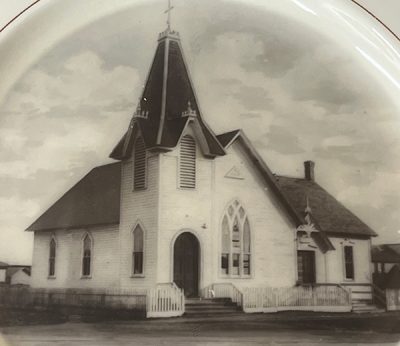
The original church on Grover St. depicted on a plate.
Missionary Roots
The first visit of Methodist missionaries to the area was in 1876. An account of that visitation appears in Phoebe Judson’s A Pioneer’s Search for an Ideal Home, “Late one Saturday night, two strangers knocked at our door…They proved to be the Reverend C.W. Tate, an English missionary and his friend Captain John, a native preacher. They had come to hold meetings with the Nooksack and were the first Protestant teachers to come among them.” Rev. Tate always spoke to the Nooksack in their native tongue and through camp meeting the next several years, managed to convert nearly every Nooksack to Methodism.
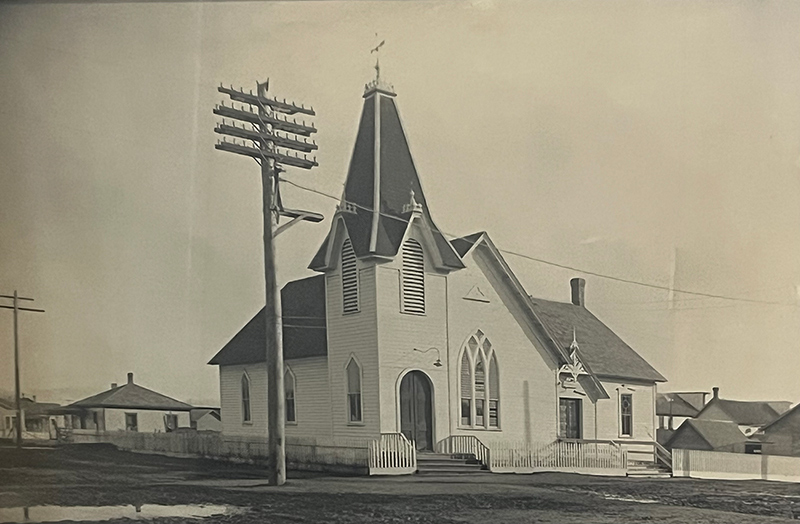
The First Church in Lynden
Organized religious activities in Lynden became more formal on April 2, 1884, when the Lynden Methodist Class became the first Methodist Episcopal Church of Lynden. As the number of settlers during the 1880’s grew, the need for a church building became apparent. The Rev. John A. Tennant was appointed the first resident pastor in 1887, and under his direction, a church was built on land donated by Mr. and Mrs. H.A. (Phoebe) Judson. The gift of land was a heavily wooded spot at the corner of Fifth and Grover Streets. Construction began and dedication of the building took place October 7, 1888 under the direction of Rev. T. J. Massey with the pastors Tennant, A. Warren and Eby assisting.
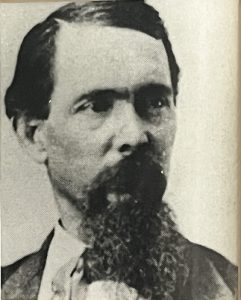
Rev. John A. Tennant
John Alexander Tennant
John A. Tennant was a native of Arkansas and the son of Thomas H. Tennant, an itinerant Methodist minister. He received a liberal education in law and civil engineering. Later he studied surveying, which is the profession he followed. Following his occupation he arrived in Sehome in 1858 to do work the Bellingham Bay Coal Company.
Tennant was the first white man to take up land on the lower Nooksack. Keeping order as a deputy sheriff during the days of the Fraser River gold rush in 1858 was one of his first civic functions. Among other positions he was county commissioner, county supervisor of schools, county surveyor, judge and, in 1859, served the district in the Territorial Legislature where he distinguished himself. It was in Olympia that he first met the Judsons.
As soon as the legislature adjourned, he returned to Whatcom, took up the position of assistant Indian agent at Lummi and soon married a Lummi woman named Clara, daughter of George Chelick. An allotment of land on the east side of the Nooksack River about a mile below Ferndale belonged to Clara and the Tennants took up residence there in 1859.
John A. Tennant resolved to join the ministry, became licensed to preach, and was appointed minister of the Ferndale church. Tennant came to the Lynden church in 1887 and served as pastor for three years.
Early Years of the Church
By virtue of its being Lynden’s only church for a number of years, the Methodist Episcopal Church of Lynden attracted all those who had religious inclinations or needs. Most couples in the area were married there, including Hans Berthusen (Berthusen Park) and Lida Hawley.
During the early part of the 1900’s, as one of the few churches in Lynden with its central location, age and the few number of outside activities, it was a social center for the community.
A New Building
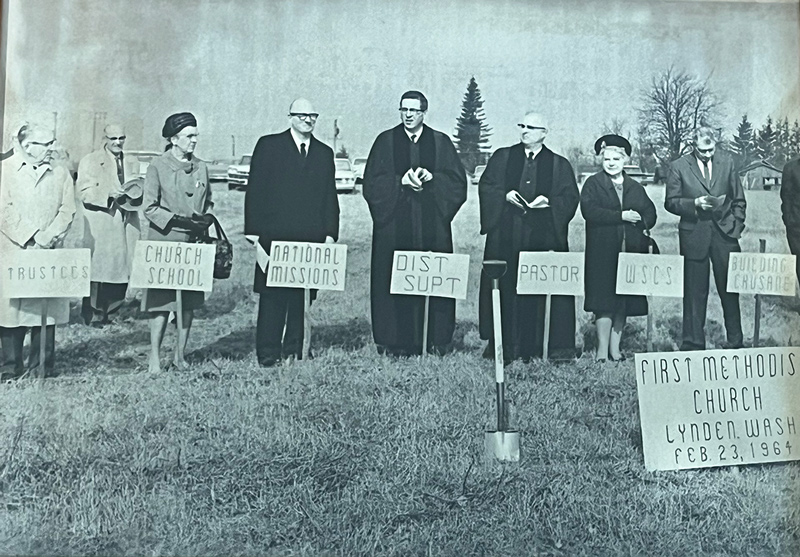
In 1959 and 1960 the need for a new church building became evident because of the ever-growing church school and the decision that it was unwise to continue making repairs on the old church building on Grover St. In addition, it was not possible to enlarge the downtown structure. A planning committee was formed and they chose the present four-acre site on Fishtrap Creek for the new building. De-commissioning services for the old church and opening services for the new church were held November 15, 1964.
In 1984, the Lynden United Methodists celebrated their 100th year in existence, while all Methodists celebrated the 200th birthday of Methodism in the United States. A Centennial Celebration was planned to hold activities throughout the year.
The Lynden United Methodist Church – A Church of Firsts
In July of 1991, Lynden United Methodist Church welcomed Lynden’s first female pastor, Rev. Joyce O’Connor. Since that time, the church has welcomed another 4 female pastors including our current pastor, Rev. Jeannette Conver.
In April of 2024, Lynden United Methodist Church became the first Reconciling Congregation in Lynden. Reconciling ministries are committed to LGBTQ+ inclusion and justice.
Today, the Lynden United Methodist Church remains at its location on N. 14th Street. Services are held every Sunday at 10:30 am and a variety of activities are held at the church throughout the week. We are committed to our mission projects in the community and endeavor to find new ways to serve our community.
“As long as there are vibrant, enthusiastic Christians in the congregation, there will be deeds accomplished that deserve recording. The achievements of today and tomorrow will inspire generations to come.” Paula Hardman, Centennial Celebration: One Hundred Years of Methodism in Lynden, 1884-1984.
**Much of this historical account was adapted from Centennial Celebration: One Hundred Years of Methodism in Lynden, 1884-1984, compiled by Paula Hardman.
A Brief History of the Methodist Church
The Methodist branch of Protestant religion traces its roots back to 1739 where it developed in England as a result of the teachings of John Wesley. While studying at Oxford, Wesley, his brother Charles, and several other students formed a group devoted to study, prayer and helping the underprivileged. They were labeled “Methodist” by their fellow students because of the way they used “rule” and “method” to go about their religious affairs.
For more information and further study of Methodism, please visit these sites:
Our Beliefs…
John Wesley’s three basic precepts that began the Methodist tradition consisted of:
Shun evil and avoid partaking in wicked deeds at all costs,
Perform kind acts as much as possible, and
Abide by the edicts of God the Almighty Father.